
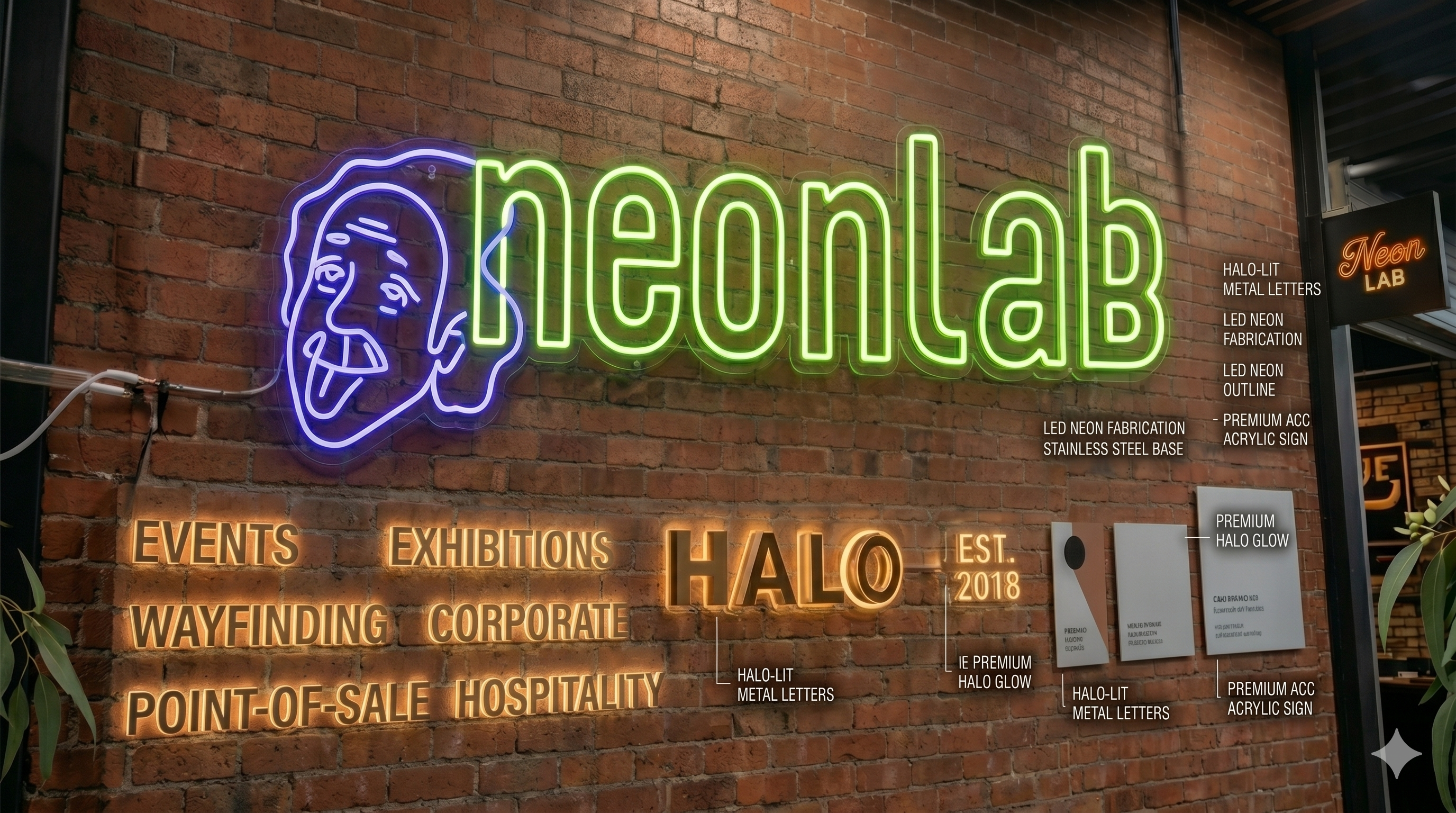
LED Neon, Halo-Lit, Backlit, Acrylic - Which Business Sign Is Right For You?
If you've started researching custom signage for your business, you've probably noticed the terminology gets confusing fast. LED neon. Glass neon. Backlit lightbox. Halo-lit 3D letters. Channel letters. Acrylic signs. What's actually different, what does each one do well, and which one makes sense for your venue, brand, or fit-out?
This guide breaks it all down — clearly, without the jargon.
First: The Difference Between LED Neon and Glass Neon
When most people say "neon sign," they're picturing one of two things — and they're not the same.
Traditional glass neon is the real thing: glass tubes hand-bent by an artisan, filled with noble gases (neon produces red-orange, argon produces blue-violet), and electrified to glow. It's the technology behind the signage of mid-century diners, Vegas casinos, and iconic city storefronts. There's a warmth and depth to glass neon that's genuinely hard to replicate — each sign is slightly unique because it's made by hand.
But glass neon has significant drawbacks for commercial use. The tubes are fragile and don't ship reliably. They run hot, operate on high voltage, require a licensed electrician for installation and repairs, and are expensive to fix when something goes wrong. For a business with a busy fit-out, multiple locations, or a tight timeline, these are real constraints.
LED neon uses flexible silicone tubing fitted with LEDs to produce a very similar glow — same visual effect, fraction of the complexity. LED neon can be up to 10 times more energy-efficient than glass, is cool to the touch, requires no electrician to install, and won't shatter if bumped. The manufacturing process is more consistent, which matters when you're ordering multiple signs for a franchise rollout or a branded fit-out with several components.
For the vast majority of commercial applications in Australia — hospitality venues, gyms, retail, franchises, events — LED neon is the right call. It's what we produce at The Neon Lab, and it's what's behind every sign you've seen on our site.
The one exception? If you're after a genuinely vintage aesthetic — a heritage pub, a jazz bar, a classic diner — authentic glass neon has a character that LED neon can approach but not fully match. It's also simply rarer, which can be part of the appeal.

Beyond Neon: The Full Range of Commercial Sign Types
Here's where a lot of businesses miss an opportunity. Neon (whether LED or glass) is one tool — a great one — but it's not always the right tool. Understanding the full toolkit means you can make a smarter decision for your space, your brand, and your budget.
LED Neon Signs
Best for: branded phrases, mottos, social media moments, hospitality walls, studio backdrops, event signage
The flexible, lightweight nature of LED neon makes it ideal for typographic and illustrative designs. Custom text, logos, and icons rendered in glowing silicone tubing — wall-mounted on clear acrylic, black acrylic, or timber backing. LED neon is roughly one-third to one-quarter the thickness of glass neon, making it a practical fit even in compact spaces like small cafes or boutiques.
This is the sign type most likely to get photographed and shared. If your goal is social media visibility, branded content, or creating a signature moment in your space, LED neon is your best option.

What to consider: LED neon works best for relatively simple designs — flowing scripts, clean icons, short phrases. For complex multi-element logos or large architectural branding, you may want to look at 3D letters or lightboxes instead.
Halo-Lit 3D Letters (Backlit Channel Letters)
Best for: building exteriors, shopfronts, premium interior branding, hotel and hospitality signage
Halo-lit 3D letters (also called reverse-channel letters) are individually fabricated dimensional letterforms — typically made from metal or acrylic — with LED lighting behind each letter rather than inside it. The light projects onto the wall behind the sign, creating a soft halo glow effect that reads as premium and architectural.
This is the sign type you'll see on the exterior of boutique hotels, upscale restaurants, and high-end retail. It's also increasingly popular indoors — mounted on a feature wall in a reception, gym, or showroom. The effect is striking, understated, and brand-consistent in a way that neon can't always achieve.
What to consider: Halo-lit letters are a more considered investment than LED neon — the fabrication is more involved and the lead time is typically longer. They're at their best for business names, wordmarks, and logos rather than decorative phrases.
Backlit Lightbox Signs
Best for: menus, wayfinding, hero brand panels, retail windows, outdoor signage
A lightbox is exactly what it sounds like: a rigid frame with a translucent face — usually printed acrylic or fabric — backlit by LEDs for a clean, even glow. The face can be printed with your full brand graphics, menu, artwork, or directional content.
Lightboxes are incredibly versatile. A café can use a lightbox as their menu board. A gym can use one for a branded hero panel on an entry wall. A retail window can use a lightbox to display seasonal campaigns or brand imagery with a level of visual quality that no other format matches at the same cost.
What to consider: The lightbox itself is a permanent investment; the printed face is what changes. If you need to update messaging (menus, seasonal promotions), a lightbox with a replaceable insert or fabric face is worth specifying from the start.
Acrylic Printed Signs
Best for: directional signage, office branding, retail shelf talkers, event signage, wayfinding
Acrylic signs are cut and printed panels — they don't light up on their own but can be incredibly effective as brand elements, directional tools, or design features. Clear acrylic with printed vinyl, frosted acrylic with cut vinyl, or full-colour UV-printed flat panels.
For businesses with a fit-out that includes neon or lightbox hero pieces, acrylic signage often handles the supporting cast — the room names, the directional arrows, the bathroom signs, the branded print walls. Done well, they pull the whole space together.
What to consider: Acrylic signs are often undervalued. If your main signage is strong but your supporting environment is generic, you're leaving brand equity on the table.
Outdoor Weatherproof Signs
Best for: shopfronts, building exteriors, car parks, outdoor events
Any of the above sign types can be built to outdoor specification — the key difference is the materials, IP rating, and structural engineering involved. Outdoor LED neon uses a different silicone grade. Outdoor lightboxes use sealed aluminium frames and weatherproof printed faces. 3D letters for outdoor use are fabricated from powder-coated aluminium.
If you're planning a shopfront or exterior installation in Australia, make sure you're specifying outdoor-rated product. UV exposure, coastal salt air, and rain will degrade a standard indoor sign significantly faster than you'd expect.
Choosing the Right Sign Type for Your Business
Here's a practical way to think about it:
If your primary goal is social media visibility and brand moments → LED neon on a feature wall
If you're branding a shopfront or building exterior → Halo-lit 3D letters or outdoor lightbox
If you need a menu board or retail display panel → Backlit lightbox with a replaceable face
If you're doing a full fit-out with multiple sign types → Combine: LED neon for the hero piece, acrylic for supporting brand elements, lightbox for the menu or feature graphic
If you're a franchise rolling out across multiple sites → LED neon or lightbox (consistent, scalable, easy to install without a trades team)
What Every Business Sign Should Include
Regardless of which type you choose, a quality sign brief covers:
- Your brand colours — Pantone or hex codes for direct colour matching
- Your brand fonts — or font preferences if you're open to recommendations
- Installation context — wall surface, approximate dimensions, indoor or outdoor, background colour
- Volume — single sign or multiple locations, because bulk orders change the economics significantly
- Timeline — if you have a fit-out date or launch deadline, flag it upfront
At The Neon Lab, every order starts with a free 3D render so you can see exactly what you're getting before anything goes into production. Our standard turnaround is under 7 days, and all signs come with a 2-year warranty on electrical components.
The Bottom Line
Glass neon is a beautiful, specialist product with real character — but for most Australian businesses, LED neon delivers the same visual impact with significantly better practical outcomes: safer, lighter, more energy-efficient, easier to install, and far more consistent across multiple units.
And if what you actually need isn't neon at all — if it's a halo-lit shopfront sign, a backlit menu board, or a set of premium acrylic room panels — knowing the full range of options means you get the right sign for your space rather than the most-talked-about one.
We work with businesses across Australia to figure out exactly what combination of signage will serve them best. Get in touch for a free consultation and 3D render.
The Neon Lab produces custom LED neon signs, halo-lit 3D letters, backlit lightboxes, acrylic signs, and outdoor weatherproof signage for Australian businesses. Free 3D render. Sub-7-day turnaround. 2-year warranty. Start your brief today.
Share:
50 Neon Sign Ideas for Businesses, Venues & Events